Restoring Blood Flow, Saving a Limb: Successful Catheter-Directed Thrombolysis for Acute Limb Ischaemia
A 76-year-old diabetic patient with acute limb ischaemia underwent successful catheter-directed thrombolysis at Sanjeev Bansal Ujala Cygnus Hospital, Karnal.
A 76-year-old man with diabetes presented with pain in his right leg below the knee that had persisted for 14 days. Evaluation revealed a significant blockage in the artery supplying the limb, placing him at risk of compromised blood flow.
At Sanjeev Bansal Ujala Cygnus Hospital, Karnal, the interventional cardiology and endovascular team used an advanced minimally invasive approach to restore blood flow and successfully salvage the affected limb.
The patient was treated by Dr. Ferooz Ahmad Banday, Consultant Interventional Cardiologist & Endovascular Specialist, through catheter-directed thrombolysis.
The Clinical Challenge
The patient presented with persistent pain in the right leg below the knee. Given the clinical presentation, further vascular evaluation was undertaken to identify the cause of the reduced blood flow.
Peripheral angiography revealed a total thrombotic occlusion of the Superficial Femoral Artery (SFA).
The blockage was preventing adequate blood flow to the lower limb and required timely intervention.
A Minimally Invasive Approach to Restore Blood Flow
Instead of proceeding directly to open surgical intervention, the medical team performed catheter-directed thrombolysis, an endovascular technique in which thrombolytic medication is delivered directly to the site of the blood clot.
The procedure was performed through the left femoral artery using a 5 French (5F) guide catheter.
The thrombolytic protocol included:
Alteplase 5 mg bolus
Followed by 1 mg/hour infusion
The infusion was continued for 25 hours
This targeted approach was used to dissolve the thrombotic obstruction and restore blood flow through the affected artery.
The Imaging Journey: From Complete Occlusion to Restored Flow
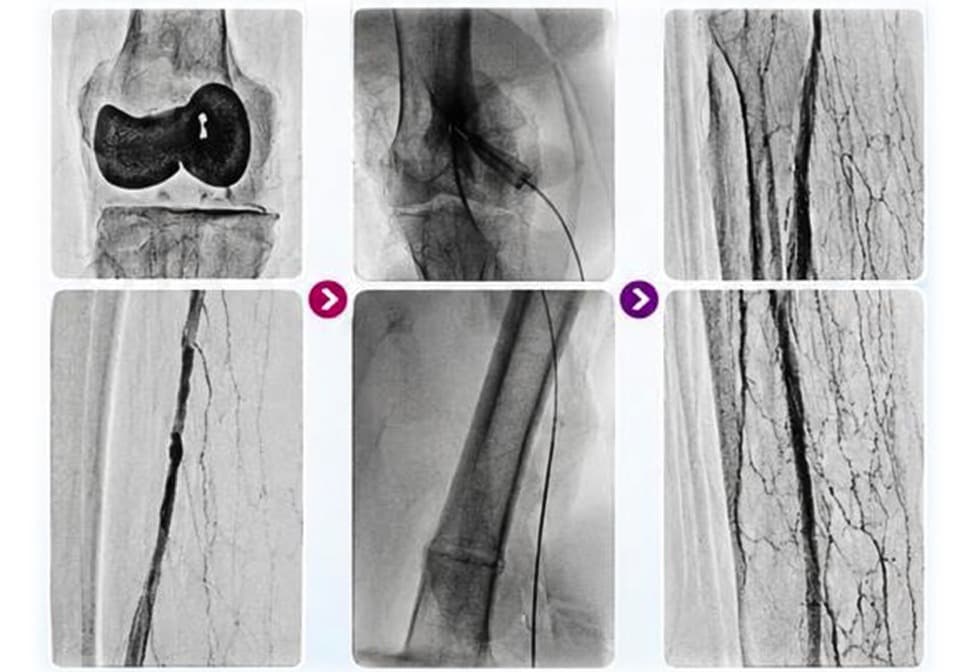
The angiographic images documented the progression of treatment.
Before Thrombolysis
Initial imaging demonstrated total thrombotic occlusion of the SFA with absent distal flow.
During Thrombolysis
Catheter-directed thrombolytic infusion was administered across the occluded segment to address the thrombotic blockage.
After Thrombolysis
Post-thrombolysis imaging demonstrated successful restoration of flow in the SFA with good distal runoff.
The sequential imaging provided clear evidence of the improvement in blood flow following the intervention.
Successful Limb Salvage
Following the procedure, the patient experienced significant symptomatic relief, along with restoration of good blood flow to the affected limb.
The follow-up assessment demonstrated:
Complete resolution of the arterial occlusion
Restoration of good distal blood flow
Significant relief of symptoms
Successful limb salvage
Stable condition at discharge
The patient was subsequently discharged in a stable condition.
Discharge Treatment
The discharge medications listed in the clinical record included:
Aspirin 75 mg once daily
Rivaroxaban 2.5 mg twice daily
Continuation of antidiabetic medication
The patient's ongoing treatment and follow-up were to be continued as advised by the treating medical team.
The Importance of Timely Intervention
Acute limb ischaemia and significant arterial blockage require timely assessment and appropriate intervention. In this case, advanced endovascular treatment enabled the medical team to address the thrombotic obstruction through a minimally invasive approach.
The successful restoration of arterial flow and the patient's symptomatic improvement demonstrate the potential role of catheter-directed thrombolysis in appropriately selected patients with thrombotic arterial occlusion.
A Limb-Saving Intervention
This case highlights how early recognition, timely intervention and advanced endovascular techniques can play an important role in restoring blood flow and preventing limb loss.
At Sanjeev Bansal Ujala Cygnus Hospital, Karnal, the coordinated efforts of the interventional cardiology and endovascular team helped achieve complete resolution of the SFA occlusion, restoration of distal blood flow and successful limb salvage.
Key Takeaway
Early recognition and timely endovascular intervention in acute limb ischaemia can help restore blood flow, relieve symptoms and, most importantly, save the limb.